|
|
|
| |
|
Iris Recognition Biometric Authentication
Information
|
|
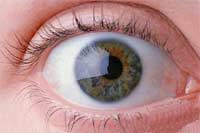
Iris scan biometrics employs the unique
characteristics and features of the human iris in order to
verify the identity of an individual. The iris is the area
of the eye where the pigmented or coloured circle, usually
brown or blue, rings the dark pupil of the eye.

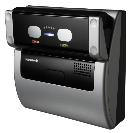
The iris-scan process begins with a
photograph. A specialized camera, typically very close to
the subject, no more than three feet, uses an infrared
imager to illuminate the eye and capture a very
high-resolution photograph. This process takes only one to
two seconds and provides the details of the iris that are
mapped, recorded and stored for future
matching/verification.
Eyeglasses and contact lenses present no
problems to the quality of the image and the iris-scan
systems test for a live eye by checking for the normal
continuous fluctuation in pupil size.
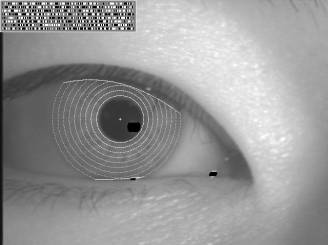
The inner edge of the iris is located by an
iris-scan algorithm which maps the iris’ distinct patterns
and characteristics. An algorithm is a series of directives
that tell a biometric system how to interpret a specific
problem. Algorithms have a number of steps and are used by
the biometric system to determine if a biometric sample and
record is a match.
Iris’ are composed before birth and, except
in the event of an injury to the eyeball, remain unchanged
throughout an individual’s lifetime. Iris patterns are
extremely complex, carry an astonishing amount of
information and have over 200 unique spots. The fact that an
individual’s right and left eyes are different and that
patterns are easy to capture, establishes iris-scan
technology as one of the biometrics that is very resistant
to false matching and fraud.
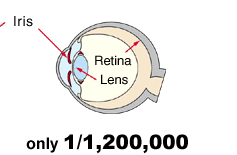
The false acceptance rate for iris
recognition systems is 1 in 1.2 million, statistically
better than the average fingerprint recognition system. The
real benefit is in the false-rejection rate, a measure of
authenticated users who are rejected. Fingerprint scanners
have a 3 percent false-rejection rate, whereas iris scanning
systems boast ratees at the 0 percent level.
Iris-scan technology has been piloted in ATM
environments in England, the US, Japan and Germany since as
early as 1997. In these pilots the customer’s iris data
became the verification tool for access to the bank account,
thereby eliminating the need for the customer to enter a PIN
number or password. When the customer presented their
eyeball to the ATM machine and the identity verification was
positive, access was allowed to the bank account. These
applications were very successful and eliminated the concern
over forgotten or stolen passwords and received tremendously
high customer approval ratings.
Airports have begun to use iris-scanning for
such diverse functions as employee
identification/verification for movement through secure
areas and allowing registered frequent airline passengers a
system that enables fast and easy identity verification in
order to expedite their path through passport control.
Other applications include monitoring prison
transfers and releases, as well as projects designed to
authenticate on-line purchasing, on-line banking, on-line
voting and on-line stock trading to name just a few.
Iris-scan offers a high level of user security, privacy and
general peace of mind for the consumer.
A highly accurate technology such as
iris-scan has vast appeal because the inherent argument for
any biometric is, of course, increased security
Benefits of Using Iris Technology
- The iris is a thin membrane on the
interior of the eyeball. Iris patterns are extremely
complex.
- Patterns are individual (even in
fraternal or identical twins).
- Patterns are formed by six months after
birth, stable after a year. They remain the same for life.
- Imitation is almost impossible.
- Patterns are easy to capture and encode
Technology Comparison
|
Method |
Coded Pattern |
Misidentification rate |
Security |
Applications |
|
Iris Recognition |
Iris pattern |
1/1,200,000 |
High |
High-security facilities |
|
Fingerprinting |
Fingerprints |
1/1,000 |
Medium |
Universal |
|
Hand Shape |
Size, length and thickness of hands |
1/700 |
Low |
Low-security facilities |
|
Facial Recognition |
Outline, shape and distribution of
eyes and nose |
1/100 |
Low |
Low-security facilities |
|
Signature |
Shape of letters, writing order,
pen pressure |
1/100 |
Low |
Low-security facilities |
|
Voiceprinting |
Voice characteristics |
1/30 |
Low |
Telephone service |
Source: AIM Japan, Automatic
Identification Seminar, Sept.14, 2001
Iris-Scan: How it Works
Dr. John Daugman's work in iris
recognition form the basis of this information. Information and images found on
his website, http://www.cl.cam.ac.uk/users/jgd1000, are presented below.
Iris recognition leverages the
unique features of the human iris to perform identification and, in certain
cases, verification.


The Iris
Iris recognition is based on visible
(via regular and/or infrared light) qualities of the iris. A primary visible
characteristic is the trabecular meshwork (permanently formed by the 8th month
of gestation), a tissue which gives the appearance of dividing the iris in a
radial fashion. Other visible characteristics include rings, furrows, freckles,
and the corona, to cite only the more familiar.
IrisCodeTM
Expressed simply, iris recognition
technology converts these visible characteristics as a phase sequence into a 512
byte IrisCode(tm), a template stored for future identification attempts. From
the iris' 11mm diameter, Dr. Daugman's algorithms provide 3.4 bits of data per
square mm. This density of information is such that each iris can be said to
have 266 'degrees of freedom', as opposed to 13-60 for traditional biometric
technologies. This '266' measurement is cited in most iris recognition
literature; after allowing for the algorithm's correlative functions and for
characteristics inherent to most human eyes, Dr. Daugman concludes that 173
"independent binary degrees-of-freedom" can be extracted from his algorithm - an
exceptionally large number for a biometric. A key differentiator of iris-scan
technology is the fact that 512 byte templates are generated for every iris,
which facilitates match speed (capable of matching over 500,000 templates per
second)
Iris Acquisition
The first step is location of the
iris by a dedicated camera no more than 3 feet from the eye. After the camera
situates the eye, the algorithm narrows in from the right and left of the iris
to locate its outer edge. This horizontal approach accounts for obstruction
caused by the eyelids. It simultaneously locates the inner edge of the iris (at
the pupil), excluding the lower 90° because of inherent moisture and lighting
issues.
Iris-Scan Issues
Iris-scan technology requires
reasonably controlled and cooperative user interaction - the enrollee must hold
still in a certain spot, even if only momentarily. Many users struggle to
interact with the system until they become accustomed to its operations. In
applications whose user interaction is frequent (e.g. employee physical access),
the technology grows easier to use; however, applications in which user
interaction is infrequent (e.g. national ID) may encounter ease-of-use issues.
Over time, with improved acquisition devices, this issue should grow less
problematic.
The accuracy claims associated with
iris-scan technology may overstate the real-world efficacy of the technology.
Because the claimed equal error rates are derived from assessment and matching
of ideal iris images (unlike those acquired in the field), actual results may
not live up to the astronomical projections provided by leading suppliers of the
technology.
Lastly, since iris technology is
designed to be an identification technology, fallback procedures may not be as
fully developed as in a verification deployment (users accustomed to
identification may not carry necessary ID, for example). Though these issues do
not reduce the effectiveness of iris recognition technology, they must be kept
in mind should a company decide to implement on iris-based solution.
Iris-Scan Applications
Iris-scan technology has
traditionally been deployed in high-security employee-facing physical access
implementations, although 2002 saw a number of novel, high-profile iris-scan
deployments in new applications. Iridian - the technology’s primary developer -
is dedicated to moving the technology to the desktop, and has had some success
in small-scale logical access deployments. The most prominent recent deployments
of iris-scan technology have been passenger authentication programs at airports
in the U.S., U.K., Amsterdam, and Iceland; the technology is also used in
corrections applications in the U.S. to identify inmates. A number of developing
countries are considering iris-scan technology for national ID and other
large-scale 1:N applications, although to date it is still believed that the
largest deployed Iridian database spans under 100,000 enrollees. Notable
iris-scan applications include the following.
|
Project Description |
Location |
Vertical Sector |
Horizontal Application
|
Application Description
|
Additional Description
|
|
Iris in Pakistan |
Pakistan |
Government |
Civil ID |
Tracking |
Afghan refugees receive assistance package on first
enrollment through UNHCR
|
|
Iris Pilot - Logan |
US-MA
|
Travel and Transportation |
Phys Acc/T&A |
Physical Access |
Iris piloted for employee access to security office
(LG3000)
|
|
JFK Iris Pilot |
US-NY
|
Travel and Transportation |
Phys Acc/T&A |
Physical Access |
1 door to tarmac protected |
|
City Hospital of Bad Reichenhall in Bavaria |
Germany |
Health care |
Phys Acc/T&A |
Physical Access |
Access control to infant center to prevent kidnappings
|
|
Singapore Border Crossing
|
Singapore |
Government |
Travel and Transportation |
Physical Access |
50k day workers enter Singapore from Malaysia daily by
motorcycle. Iris-scan does 1:N |
|
UK Passport Office Iris Pilot |
UK
|
Government |
Civil ID |
Passport |
Opt-in pilot to test iris acceptance, part of 6-mo public
comment period
|
|
Venerable Bede (UK) School - Iris
|
UK
|
Education |
Retail/ATM/POS |
POS
|
900-pupil school to use Iridian for library check-out and
cafeteria payment |
Iris-Scan Market Size
Though it is one of the later
emerging technologies in the biometric market, iris-scan is set to grow
substantially through 2007. Iris-scan offers low false match rates and
hands-free operation, and is the only viable alternative to fingerprint
technologies in 1:N applications where a single record must be located.
Iris-scan's resistance to false matches is offset somewhat by the the level of
training required to use the system effectively. As such, iris-scan will
primarily be used in applications that require high levels of security, although
convenience-driven deployments (e.g. Privium) will continue. Iris-scan revenues
are projected to grow from $16.2m in 2002 to $210.2m in 2007. Iris-scan revenues
are expected to comprise approximately 5% of the entire biometric market.
Iris Recognition Time Attendance Access control systems India,
Biometric, Biometric security services, Biometric solutions,
Biometric technology, Biometric fingerprint, Biometric companies,
Biometric fingerprint, Biometric research, Biometric books,
biometric tutorials, biometric india, biometric access, biometric
contact pune, bioaccess, biometric products, fingerprint india, time
attendance, fingerprint access control, time cards, biometric
identification, biometric research, biometric solutions, biometric
services, biometrics ,Biometrics India, USA, America, Europe, Japan,
UK, Germany, france, uae, singapore. |
|
more information
about biometrics visit following website
|
|
 |
|
|
|
|
|
.: Related Products :. |
|
|
|
FSM9000 |
|
 |
|
 |
|
|
|
Hamster |
|
 |
 |
|
|
|
FDA01 |
|
 |
 |
|
FIM01 |
|
 |
 |
|
|
|
|
|
|
|
|
|
|
|
|
|
|
|
|
|
|
|
|
|
|
|
|
Home |
Services
| Products
| Solutions
| Support
|
Partners
|
Careers
| Contact
Us |
|
|
/
|
|
 |
|
India, USA
(New York, California), UK, Dubai, UAE,
Oman, Bahrain, Saudi Arabia, Australia,
south Africa, Canada, America, middle
east, Europe, Asia, Argentina, Austria,
Azerbaijan, Bahamas, Bangladesh,
Belgium, Bhutan, Brazil, Brunei,
Bulgaria, Burma, Cameroon, Canada,
Chile, China, Colombia. Congo, Costa
Rica, Croatia, Cuba, Cyprus, Czech
Republic, Denmark, East west north
south, Ecuador, Egypt, England, c
Laos, Malaysia, Maldives, Islands,
Mauritius, Mexico, Myanmar, Nepal, The
Netherlands, New Zealand, Nigeria,
Ireland, Norway, Oman, Pakistan,
Philippines, Poland, Portugal, Qatar,
Romania, Russia, Saudi Arabia, Scotland,
Seychelles, Sierra, Property
Singapore, South Africa, Spain, Sri
Lanka, Sudan Sweden, Switzerland, Syria,
Taiwan, Tanzania,
impact components
Thailand, Trinidad, Tunisia, Turkey,
United Arab
investmentsEmirates,
United Kingdom, Britain, United States
of America, Vatican, Venezuela,
Vietnam, Wales, Zimbabwe |
|
Ahmedabad,
Agra, Allahabad, Amritsar, Aurangabad,
Bangalore, Baroda, Bhopal, Bhubaneshwar,
Bikaner, Calicut, Chennai (Madras),
Chandigarh, Coimbatore, Dehradun,
Faridabad, Gandhinagar, Gwalior,
Guwahati, Hyderabad, Indore, Jaipur,
Jalandhar, Jammu, Kanpur, Kholapur,
Kochi (Cochin), Kolkata (Calcutta),
Lucknow, Ludhiana, Mumbai (Bombay),
Mysore, Nagpur, Nashik, New Delhi,
Patna, Pondicherry, Pune, Raipur,
Rajkot, Ranchi, Sangli, Sholapur,
Shimla, Srinagar, Surat, Thane, Trichi,
Thiruvananthapuram (Trivandrum),
Udaipur, Vadodara, Varanasi, Vijayawada,
Vishakhapatnam, Goa Andhra Pradesh,
Assam, Bihar, Goa, Gujarat, Karnataka,
Madhya Pradesh, Maharashtra, Orissa,
Punjab, Rajasthan, Tamil Nadu, West
Bengal, Chandigarh, Delhi
ayurvedic
Devlopement,
USB, Optical, cards, Sensors, Software
Biometrics Andhra Pradesh, Assam, Bihar,
Goa, Gujarat, Karnataka, Biometric
Madhya Pradesh, Biometrics Maharashtra,
Orissa, Punjab, Fingerprint Rajasthan,
Biometric Tamil Nadu, West Bengal,
Biometric Chandigarh, Delhi |
|
|
|
|
|