|
Biometrics Fingerprint Technoloy India Time Attendance IndiaBiometric Biometric security
services Biometric solutions Biometric technology Biometric
fingerprint Biometric companies Biometric fingerprint Biometric
research Biometric books biometric tutorials biometric india
biometric access biometric contact pune bioaccess biometric
products fingerprint india time attendance fingerprint access
control time cards biometric identification biometric research
biometric solutions biometric services biometrics Biometrics
India USA America Europe Japan UK Germany france uae singapore Time a |
|
|
:: Why
Fingerprints? |
|
With increasingly urgent need for
reliable security, biometrics is being spotlighted as the
authentication method for the next generation. Among numerous
biometric technologies, fingerprint authentication has been in
use for the longest time and bears more advantages than other
biometric technologies do.
Fingerprint authentication is
possibly the most sophisticated method of all biometric
technologies and has been thoroughly verified through various
applications. Fingerprint authentication has particularly proved
its high efficiency and further enhanced the technology in
criminal investigation for more than a century.
Even
features such as a person’s gait, face, or signature may change
with passage of time and may be fabricated or imitated. However,
a fingerprint is completely unique to an individual and stayed
unchanged for lifetime. This exclusivity demonstrates that
fingerprint authentication is far more accurate and efficient
than any other methods of authentication.
Also, a
fingerprint may be taken and digitalized by relatively compact
and cheap devices and takes only a small capacity to store a
large database of information. With these strengths, fingerprint
authentication has long been a major part of the security market
and continues to be more competitive than others in today’s
world. |
|
|
:: History
of Fingerprint Technology |
|
The beginning of fingerprints goes
back to as early as the ancient times. According to historical
findings, fingerprints were used on clay tablets for business
transactions in ancient Babylon. In China, thumb prints were
found on clay seals. But it was in the 19th century that the
results of scientific studies were published and fingerprint
technology began to be considered more seriously.
Using
the1800’s scientific studies as a foundation, fingerprint
technology was already in use by the beginning of the 20th
century. In 1924, FBI(Federal Bureau of Investigation) is
already known to have maintained more than 250 million civil
files of fingerprints for the purpose of criminal investigation
and the identification of unknown casualties. In the late
1960's, fingerprint technology met a great turning point when it
gave birth to 'live-scan,' a method to obtain a fingertip image
without the use of print ink. When the FBI announced that it
planned to stop using paper fingerprint cards inside their new
Integrated AFIS (IAFIS) site, it was actually announcing the
remarkable breakthrough of today's live-scan technology.
But fingerprint identification technology did not stop as a
forensic method only. It was officially used for business
purposes in 1968 at one security corporation in Wall Street.
Fingerprints are now being used as a secure and effective
authentication method in numerous fields, including financial,
medical, e-commerce and entrance control applications. Modern
applications of fingerprint technology rely in large part on the
development of exceptionally compact fingerprint sensors.
|
|
top
|
|
|
:: Fingerprint
Identification Process |
|
|
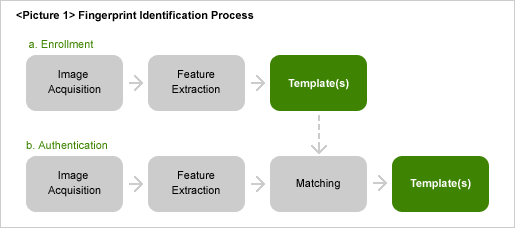
Fingerprint identification process
consists of two essential procedures: enrollment and
authentication. Taking the following steps completes each
procedure: |
 |
|
As shown in the diagram above,
fingerprint identification system compares the input fingerprint
image and previously registered data to determine the
genuineness of a fingerprint. All the steps described above
affect the efficiency of the entire system, but the
computational load of the following steps can be reduced to a
great extent by acquiring a good-quality fingerprint image in
the first step. |
|
Step 1. Image
Acquisition |
|
Real-time image
acquisition method is roughly classified into
optical and non-optical. Optical method relies on
the total reflection phenomenon on the surface of
glass or reinforced plastic where the fingertip is
in contact. The sensor normally consists of an
optical lens and a CCD module or CMOS image sensor.
In contrast, semiconductor sensors, as a typical
example of non-optical sensors, exploit electrical
characteristics of a fingertip such as capacitance.
Ultrasonic wave, heat, and pressure are also
utilized to obtain images with the non-optical
fingerprint sensors. Non-optical sensors are said to
be relatively more suitable for massive production
and size reduction such as in the integration with
mobile devices. Detailed comparison is found in
Table 1. |
|
Optical |
Non-optical |
|
Measuring
Method |
light |
pressure, heat,
capacitance, ultrasonic wave |
|
Strength |
highly-stable
performance physical/electrical durability
high-quality image |
low cost with mass
production compact size integrated with
low-power application |
|
Weakness |
relatively high
cost limit to size-reduction relatively
easy to fool with a finger trace or fake finger |
physical/electrical weakness performance
sensitive to the outer environment(temperature,
dryness of a finger) |
|
Application |
entrance, time,
and attendance control banking service PC
security |
PC security
e-commerce authentication mobile devices &
smart cards | |
|
|
Step 2. Feature
Extraction |
|
There are two main
ways to compare an input fingerprint image and
registered fingerprint data. One is to compare an
image with another image directly. The other is to
compare the so-called 'features' extracted from each
fingerprint image. The latter is called
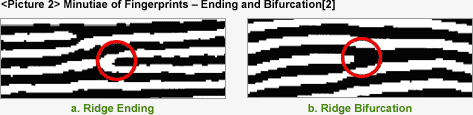
feature-based/minutia-based matching. Every finger
has a unique pattern formed by a flow of embossed
lines called “ridges” and hollow regions between
them called “valleys.” As seen in the Picture 2
below, ridges are represented as dark lines, while
valleys are bright. |
 |
|
|
|
Step 3. Matching |
The matching step is
classified into 1:1 and 1:N matching according to
its purpose and/or the number of reference
templates. 1:1 matching is also called personal
identification or verification. It is a procedure in
which a user claims his/her identity by means of an
ID and proves it with a fingerprint. The comparison
occurs only once between the input fingerprint image
and the selected one from the database following the
claim by the user.
On the contrary, 1:N
matching denotes a procedure where the system
determines the user's identity by comparing the
input fingerprint with the information in the
database without asking for the user's claim. A good
example of this is AFIS(Automated Fingerprint
Identification System) frequently used in criminal
investigation.
The output result of the
matching step is whether or not the input
fingerprint is identical to the one being compared
in the database. Then how could the accuracy of the
matching procedure be represented in number? The
simplest measures are FRR(False Reject Rate) and
FAR(False Accept Rate). The former is the rate of
genuine user's rejection and the latter is the rate
of impostor's acceptance.
| |
| | |
|
|
:: Fingerprint
Application |
|
|
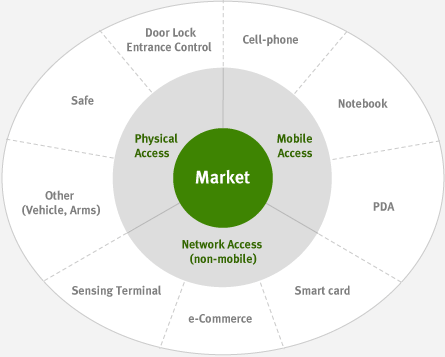
Markets for fingerprint technology
include entrance control and door-lock applications, fingerprint
identification mouses, fingerprint mobile phones, and many
others. The fingerprint markets are classified as follows: |
|
|
As the advanced technology enables
even more compact fingerprint sensor size, the range of
application is extended to the mobile market. Considering the
growing phase of the present mobile market, its potential is the
greatest of all application markets. |
|
|
References
|
|
[1] International Biometric
Group,「Biometric Market Report 2000-2005」, 2001. |
|
[2] Anil K. Jain, Lin Hong,
Sharath Pankanti, Ruud Bolle,「An Identity Authentication System
Using Fingerprints」, 1997.
|
|
[3]
http://onin.com/fp/fphistory.html
|
|
|
ttendance india access control india biometric india security india Fingerprint india Precise Biometrics
Biometric Biometrics Security Biometrics Information Bio Biometrics india Biometric Fingerprint scanner Time attendance Access
control OEM modules security Time cards SDK USB finger print
sensor Authentication Identification Verification Biometrics
time attendance Biometrics access control Fingerprint time
attendance Fingerprint access
control Proximity RFID smart cards Software Hardware free low cost cheapest
products Solutions project services development matching
recognition
top
|
|
more information
about biometrics visit following website
|
| |
|

|